Coterminous · Doctrine Module · Unit Four
Redemption
The Doctrine of Christ’s Cross
Scripture Dynamics · Like Precious Faith · Don T. Chavis
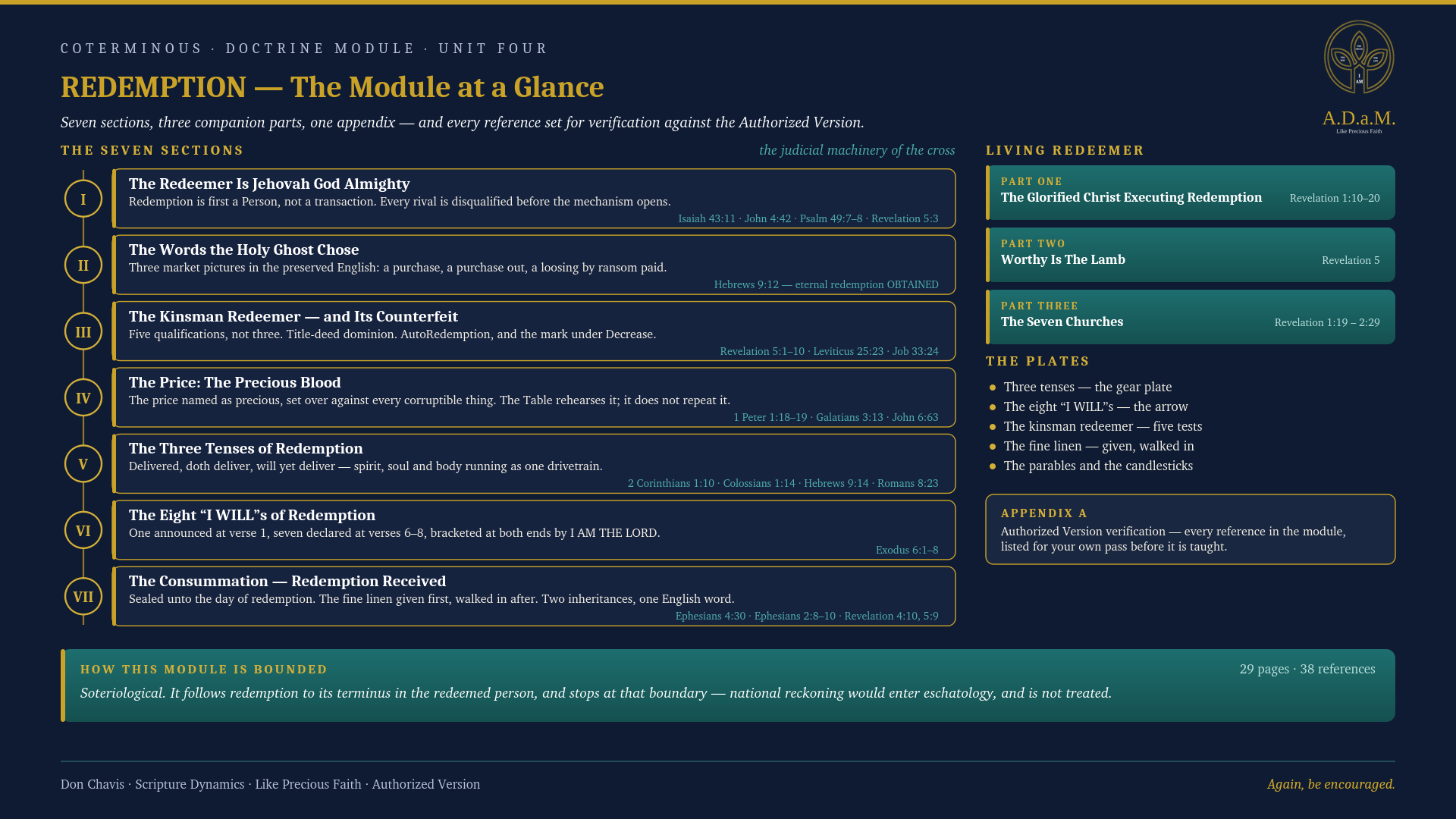
This is a soteriological teaching — the judicial machinery of the cross. It follows redemption to its terminus in the redeemed person and stops at that boundary.
National reckoning is not addressed. To treat it would enter the realm of eschatology, whether individual or national, and that is not the office of this module.
Every scripture reference herein is set for personal verification against the Authorized Version before teaching, recording, or publication. See Appendix A.
I.The Redeemer Is Jehovah God Almighty
Redemption is not first a transaction to be explained. It is first a Person to be identified. Every question about the price, the payment, and the purchased depends on who the Redeemer is — and Scripture forecloses the matter before it opens the mechanism.
Set the two together and the conclusion is unavoidable: CHRIST IS JEHOVAH GOD ALMIGHTY.
The same identification is made by the blood itself. The church is not purchased by an agent of God, nor by a creature commissioned for the task. It is purchased with God’s own blood.
cf. 1 Peter 1:19 · Luke 1:68 · Job 19:25
—No man may stand in the office
Before the Redeemer is named, every rival is disqualified. The Psalm shuts the door on kinship, on wealth, and on sincerity alike.
The disqualification is not left as an argument. In Revelation 5 it is put to open search through the whole of creation, and the search fails.
In heaven — no angel, no saint. In earth — no preacher, scholar, pope, or priest. Under the earth — no demon. cf. Romans 3:10–12 · Isaiah 63:5
And at the far end of the Book the returning King wears a name that belongs to Jehovah alone — Jeremiah 23:6, THE LORD OUR RIGHTEOUSNESS. The identification with which redemption begins is the identification with which it closes.
II.The Words the Holy Ghost Chose
The doctrine is carried in the English words of the preserved text. Read them as they stand, and the transaction sorts itself into three distinct pictures — a purchase, a purchase out, and a loosing by ransom paid.
| The English word | Where it stands | What it carries |
|---|---|---|
| Redeem, redeemed | Galatians 3:13; 4:5; 1 Peter 1:18; Revelation 5:9 | To buy, and to buy out of a market — the purchase and the removal. |
| Redemption | Colossians 1:14; Ephesians 1:7, 14; Romans 8:23; Hebrews 9:12 | The loosing that follows a ransom actually paid — not offered, paid. |
| Ransom | Matthew 20:28; 1 Timothy 2:6 | The price itself, and the price set over against the one ransomed. |
| Redeemer | Job 19:25; Isaiah 59:20 | The office, held by a Person — kinsman, able, and willing. |
| Purchased | Acts 20:28; Ephesians 1:14 | A possession acquired and retained — the purchased possession. |
Obtained. Not attempted, not offered — obtained, and eternal.
III.The Kinsman Redeemer — and Its Counterfeit
The office of redeemer is not invented at Calvary. It is written into the law long before, and it carries three qualifications that no volunteer can supply for himself: the redeemer must be kin, he must be able to pay, and he must be willing.
cf. Leviticus 25:47–49 · Ruth 3:9; 4:1–10 · Jeremiah 32:6–9
—The office put to open search — and five tests, not three
Revelation 5 does not assume a redeemer. It advertises the office and waits. A strong angel proclaims the qualification aloud, and the qualifications are five — the last two of which shut the door on self-redemption from the opposite side.
| The qualification | Where it stands |
|---|---|
| He must be a kinsman. | Leviticus 25:25, 48–49; Ruth 3:12–13; Hebrews 2:14–15 |
| He must be able to redeem. | Ruth 4:4–6; Jeremiah 50:34; John 10:11, 18 |
| He must be willing to redeem. | Ruth 4:6; John 10:18; Philippians 2:5–8 |
| He must not need redemption himself. A slave could not buy a slave. | 2 Corinthians 5:21; 1 Peter 2:24 |
| He must pay the debt in full. | 1 Peter 1:18–19; Galatians 3:13 |
Kinship, ability and willingness establish who may hold the office. The fourth and fifth qualifications establish who may not. A redeemer who himself needed redeeming could pay nothing — a slave could not buy a slave — and a debt paid in part is a debt still owed. Together they are the exact refutation of AutoRedemption, approached from the other side: not that self-righteousness is weak, but that the self is disqualified from the office before it begins.
The fourth qualification, stated positively — who knew no sin. cf. 1 Peter 2:24
All five are answered in one Person. Kin, by taking part of the same flesh and blood. Able, because the blood is without blemish and without spot. Willing, because no man took his life from him. Unindebted, because he knew no sin. And paid in full, because what he obtained was eternal redemption — not a payment renewed.
cf. Hebrews 2:15–17 · John 10:18
Redemption and adoption in one clause — the purchase and the placing.
—What the Redeemer reclaims — title-deed dominion
The book in the right hand of him that sat on the throne is written within and on the backside, so that nothing can be added to it or altered. It reads as the title deed to creation — dominion given, dominion lost, dominion reclaimed — and the Jewish law of land redemption is the pattern behind it: the land was never sold for ever, because the land is the LORD’s.
cf. Daniel 7:13–14 · Jeremiah 32:6–15 · Leviticus 25:23–25 · Ruth 4 · Ezekiel 2:9–10
The ground of every kinsman redemption — the title never left the Owner.
Title-deed dominion. The same scene as Revelation 5:1–7.
And everything hangs on whether the office is filled. John weeps in Revelation 5:4 not for a lost book but for a lost creation — for if no redeemer is found, the curse is not lifted and the usurper keeps the ground. That is the weight the five qualifications are carrying.
The search of Revelation 5:2–3 and the finding of Job 33:24, set together.
—AutoRedemption — the counterfeit office
Auto- means self. An autobiography is a life written about oneself. AutoRedemption is a redemption attempted upon oneself, without external intervention — and Scripture is blunt about its outcome. Our own righteousness is not merely weak. It is named iniquity.
cf. Matthew 7:23 · Isaiah 64:6
—The mark and the token — Decrease
One English word carries the whole contrast. A mark is set upon Cain, and it preserves him. A token is set upon the houses in Egypt, and it preserves them. The same Hebrew word stands behind both. The difference is not the mark. The difference is whose works are in view.
The LORD does not look for the household. He looks for the blood.
cf. 2 Thessalonians 2:7
Galatians 6:17 — “for I bear in my body the marks of the Lord Jesus” — stands over against Galatians 6:13, where the flesh is gloried in. Cain was marked and preserved while his own works were evil; the doorpost was marked and preserved by blood; Paul bears marks and does not glory in them. All of it under John 3:30 — Decrease.
This is an English-word study across both testaments, not a claim that one original word underlies every occurrence. It is built on the preserved English as it stands.
IV.The Price: The Precious Blood
The price is named, and it is named as precious — set explicitly over against every corruptible thing that men would offer in its place.
cf. Romans 3:24–25 · Ephesians 1:7 · Matthew 20:28 · 1 Timothy 2:6
—The Table — the price rehearsed, not repeated
The setting of Matthew 26 is the Passover under the law: unleavened bread, blessed; and the unfermented fruit of the vine, given with thanks. Fermentation and leaven both stand in Scripture as a typology of sin and sinfulness, and neither is present at this table.
Setting: Passover celebration under the law — Matthew 26:19 cf. Exodus 12.
Unleavened bread (blessed) and unfermented drink, “fruit of the vine” — Matthew 26:29; Isaiah 65:8; Deuteronomy 32:14; cf. Proverbs 23:31.
“…this is my blood…” is figurative and not literal at the table, because the blood is not yet shed — Matthew 26:28.
No need of transubstantiation — cf. Revelation 2:18–29; 1 Kings 18:26–28; and decisively, John 6:63.
cf. John 6:47–51 — the living bread; John 6:61–62 — omniscience and omnipresence.
The source plate reads MATTHEW 26:26–30 cf. 25:31–34, and the second citation is a different chapter. Verses 31–34 are Matthew 25, cited for the throne and the King — “the throne of his glory” and “Then shall the King say”. The sorting in verses 32–33 is not the subject of this module and is not expounded here.
V.The Three Tenses of Redemption
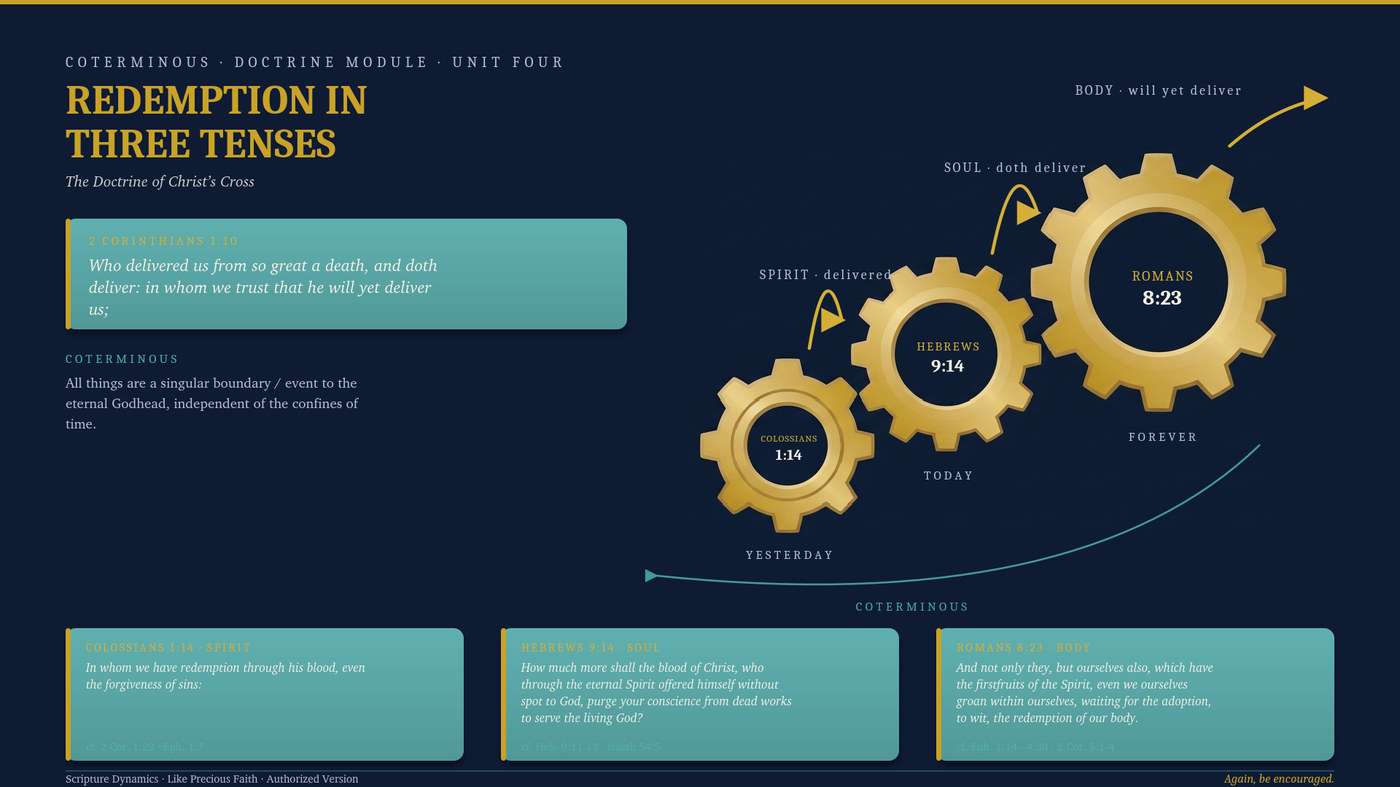
One verse governs the whole plate. Deliverance is stated in three tenses, and the tenses do not compete — they run as one drivetrain.
| Tense | The faculty | The scripture |
|---|---|---|
| Yesterday — delivered | The spirit | Colossians 1:14; 2 Corinthians 1:21–22; Ephesians 1:7 |
| Today — doth deliver | The soul | Hebrews 9:14 cf. 9:11–13; Isaiah 54:5; Titus 2:14 |
| Forever — will yet deliver | The body | Romans 8:23; Philippians 3:21; Ephesians 1:14; 4:30; 2 Corinthians 5:1–4 |
cf. 2 Corinthians 1:22 · Ephesians 1:7
cf. Hebrews 9:11–13 · Isaiah 54:5
cf. Ephesians 1:14 · 4:30 · 2 Corinthians 5:1–4
—Glorification is the terminus, not a fourth station
Faith and repentance — trusting the finished work of Christ’s cross — quicken and glorify the spirit of man, and that quickening belongs to the judicial machinery itself. The quickening and glorifying of the body happens coterminously in the mind of Christ; but its literal terminus is post-haste future. Glorification therefore enters the machinery at one end and is completed at the other. It is not a station on the plate. It is the plate’s terminus.
cf. Philippians 3:21 · 1 Corinthians 15:45 · 1 Corinthians 15:52
And the reach of it is not the believer only. The creature groans with him, and is named in the same deliverance — Romans 8:21. Isaiah 57:15 holds the One that inhabiteth eternity; John 2:21 speaks of the temple of his body; 2 Peter 1:14 of putting off this tabernacle. The body is not incidental to redemption. It is the last thing redeemed.
All things are a singular boundary / event to the eternal Godhead, independent of the confines of time. Read the three tenses from that vantage and they are one boundary, not three systems — creation’s history and an individual’s existence molded together on a single prophetic timeline.
VI.The Eight “I WILL”s of Redemption
Exodus 6 rehearses the whole doctrine in the first person, and the count runs to eight. The first is announced before the rehearsal begins — “Now shalt thou see what I will do to Pharaoh” at verse 1. The remaining seven are then declared in verses 6 through 8, bracketed at both ends by the same declaration — I AM THE LORD — and ordered in the same three tenses as the plate. One announced, seven declared.

The eight “I WILL”s — one announced at Exodus 6:1, seven declared at 6:6–8, bracketed at both ends by I AM THE LORD.
| The tense | The “I WILL” | Where |
|---|---|---|
| Announced — the opening | I will do to Pharaoh | Exodus 6:1 |
| Past — positional | I will bring you out; I will rid you; I will redeem you | Exodus 6:6 |
| Present — progressive | I will take you to me; I will be to you a God | Exodus 6:7 |
| Future — perfection | I will bring you in; I will give it you for an heritage | Exodus 6:8 |
The eighth “I will” — announced before the seven are declared.
The posture of the redeemed while the Redeemer works.
VII.The Consummation — Redemption Received
Redemption is purchased at the cross and received at the end. The earnest is given now; the possession is entered then — and the seal that holds between the two is dated to the very thing it waits for.
cf. Ephesians 1:13–14 — sealed until the redemption of the purchased possession.
The seal cannot expire before the day it is dated to. That single fact settles what follows.
—The fine linen — given first, walked in after
Revelation 19:8 calls the fine linen the righteousness of saints, and the objection writes itself: is the bride then clothed in her own merit? Ephesians answers it in two verses, and those two verses are a spiritual echo of Zechariah 3 — respectively.
Echoed in Zechariah 3:4–5 — the filthy garments taken away, the iniquity caused to pass, the raiment given. Joshua does nothing.
Echoed in Zechariah 3:7 — “If thou wilt walk in my ways… then thou shalt also judge my house, and shalt also keep my courts.”
The garment is given before any condition is named. The walk follows, and even the works walked in are his workmanship, before ordained. So the linen is never independent merit, and Isaiah 54:17 stands unbroken — their righteousness is of me, saith the LORD. Note also the verbal hinge: walk, in Ephesians 2:10 and three times over in Zechariah 3:7.
—Two inheritances, one English word
Scripture uses the word inheritance for two different things, and collapsing them is what produces every anxiety on this subject.
| Received by | Its character | |
|---|---|---|
| Inheritance by sonship | Galatians 4:7 — “if a son, then an heir of God through Christ” | Standing. Kept by the power of God — 1 Peter 1:3–5. Not forfeitable. |
| Inheritance as privilege | Zechariah 3:7; 1 Corinthians 3:11–15 | State. Administrative reward for the walk. Loss is possible here, and only here. |
cf. 2 Corinthians 5:10 — the judgment seat of Christ.
Loss of rewards does not equate to the unsealing of the one who has trusted in Christ. Where reigning and inheritance are spoken of as forfeitable, the scene stands after the judgment seat of Christ and concerns already-redeemed believers — read from the vantage point of Scripture as a historical prophetic timeline of creation history molded together with an individual’s existence.
The distinction is Stand and State. Redemption is Stand. Reward is State. The seal belongs to the first and is never at issue in the second.
—The Bride is not among them
One further boundary, stated and not expounded. After Acts 2 the Spirit of Christ does not edify the blood-bought truster in Christ by calling him a sheep. Sheep language belongs to a nation; the church is the Bride, awaiting complete marital consummation — also known as the redemption of our body. Where a sorting of sheep and goats appears, the Bride is not among them. That is the whole of what this module says about it.
Both administrations have their linchpin in the same Person and Work of Christ, even though the Bride is not among them — and that linchpin, not a chart of programs, is how the distinction is handled here.
The stewardship and the gathering into Christ, in one clause.
—The crowns cast — nothing terminates in the saint
And here the whole question of reward under grace is answered. Whatever is credited, is cast. The crown exists in order to have something to lay down.
A garment we did not buy, works that are his workmanship, a crown given and then surrendered. Nothing terminates in the redeemed. Everything returns to the throne — and in that same throne room the redemption itself is named and the price with it.
And the two chapters divide the worship between them. In Revelation 4 he is worshipped as the Creator; in Revelation 5, as the Redeemer. The crowns are cast in the first; the price is named in the second.
Coterminous · Source Organization · Companion to Unit Four
—LIVING REDEEMER — WORTHY IS THE LAMB
Revelation 1, 2 and 5 — transcribed commentary, arranged
Scripture Dynamics · Like Precious Faith · Don T. Chavis
The Seven Churches remain. The candlesticks cannot be separated from the Redeemer himself — Christ stands in the midst of them (Rev. 1:13) and at the door (Rev. 3:20). The access point to the bridge of eschatology remains faithfully with Christ at the door of organized corporate worship, in conjunction with professing believers. Part Three is therefore carried in full, and the Matthew 13 comparison is added to it. Revelation 5 remains the chapter that feeds Unit Four most directly — it is the kinsman-redeemer chapter.
—Where each part goes — Redemption
| Part | Scripture | Destination |
|---|---|---|
| Part One — The Glorified Christ | Revelation 1:10–20 | Partly Unit Four — Section I (the Redeemer is Jehovah) and Section VII (the keys purchased by blood). The Sunday/sabbath argument is a separate subject. |
| Part Two — Worthy Is The Lamb | Revelation 5 | Unit Four — Section III (kinsman redeemer) and Section VII (the close). This is the on-point chapter. |
| Part Three — The Seven Churches | Revelation 1:19 – 2:29 cf. Matthew 13 | Retained. Christ in the midst of the candlesticks and at the door — the bridge to what follows is the Redeemer himself, not a program. Carries the Matthew 13 comparison. |
—Part One. The Glorified Christ Executing Redemption
Revelation 1:10–20.
—Verse 10 — the Lord’s day
“Lord’s day” Not “the day of the Lord.” That is chapter 19, and John is not there yet. This is Sunday, the first day of the week.
—Seven reasons given for worship on the first day:
The sabbath was a sign to the nation of Israel, not to the church — Neh. 9:14; Ex. 31:13–17.
The Law, including the fourth commandment at Ex. 20:9–11, was fulfilled in Christ — Matt. 5:17; Rom. 10:4; Acts 13:29, 39; Col. 2:14–17.
On Sunday the apostles met for preaching and fellowship and for collecting the tithes and offerings — Eph. 2:20; Acts 20:7; I Cor. 16:2.
Christ redeemed us from the Law — Gal. 3:13; 5:1; Rom. 14:5–6.
The first day was made holy before the seventh — Ex. 12:15–16; Neh. 9:13–14.
Sabbath means “rest,” not worship — Heb. 4.
Sunday is resurrection day — Jn. 20:1, 19, 26.
“voice” God’s voice is great, majestic, authoritative. cf. Ps. 29.
—Verse 11 — the seven churches, three ways
“churches” (1) Historically, seven local churches of John’s day in Asia Minor. (2) Prophetically, seven divisions of church history through this age. (3) Spiritually — (a) seven types of churches in any period, one type dominant; (b) seven characteristics that can exist in any church or Christian.
—Verses 12–16 — the Lord of judgment
cf. I Cor. 15:25. Christ is here the Lord of judgment — no longer the “Lamb of God” but now “the Lion of the tribe of Juda.” The Son of man is described in Song of Solomon 5:10–15. Here it is the Son of God from eternity (Mich. 5:2). The Ancient of days — Dan. 7:9–13. The “child” was born in Bethlehem, but the “Son” of Isa. 9:6 is “from everlasting” — Jn. 10:30.
“midst” (v. 13) The Lord judging in the midst of His assemblies — Matt. 18:20.
—Verses 13–16 — ten things about the Son of man
| The item | What it carries |
|---|---|
| “Son of man” (v. 13) | A human-looking figure. cf. I Tim. 2:5. |
| “garment” (v. 13) | He wears the robe of the High Priest. |
| “girdle” | Authority, truth — Isa. 11:5; Eph. 6:14. Gold speaks of deity, the righteousness of God. |
| “head” (v. 14) | White — wisdom, age. Christ is the wisdom of God — Prov. 8:1, 22; I Cor. 1:30. |
| “eyes” (v. 14) | cf. Heb. 4:13. |
| “feet” (v. 15) | Like brass — judgment. cf. Mal. 4:3; Heb. 10:13. |
| “voice” (v. 15) | Thunders as a great water. cf. v. 10 note; Jn. 12:29. |
| “he had” (v. 16) | The churches (v. 20), and thus individual Christians, are in His hand — Jn. 10:27–29; Ps. 37:23–24. |
| “sword” (v. 16) | cf. Heb. 4:12; Rev. 19:15; Eph. 6:17. |
| “countenance” (v. 16) | The sun as a type of Christ — Mal. 4:2. See the five-part note following. |
—The head (v. 14) — four statements of deity
The Jehovah (“Ancient of days”) of the Old Testament is the Jesus of the New, under the same description — Dan. 7:9–13; Mic. 5:2.
Christ is God “manifest in the flesh” — I Tim. 3:16.
This is Christ in His eternal glory — Jn. 17:5; Matt. 17:2.
This is the One to whom all judgment has been committed — Jn. 5:22, 27; II Cor. 5:10. This is the Lion of the tribe of Judah.
—The countenance (v. 16) — the sun as a type
cf. Acts 9:3, 17 with I Cor. 9:1. Malachi 4:2 pictures Christ as the sun. The sun is a type of Christ; the moon types the church — Song 6:10.
The sun appeared on the fourth day — Gen. 1.
The Son appeared 4000 years after Adam — II Pet. 3:8.
When the sun sets — the evening comes first, Gen. 1 — it is blood red, a picture of Christ’s death.
When it rises, at the Second Advent of Mal. 4:2, it is again blood red — Isa. 63:1–6; Ps. 19:1–6. cf. Rom. 1:19, 20; Jn. 1:9.
“shineth” (v. 16) cf. II Thess. 2:8; Rev. 21:23.
—Verses 17–20 — four reasons a Christian should not fear
Verse 17: John’s reaction. As a sinful mortal he collapses before deity — Lu. 5:8; Dan. 10:5–12; Isa. 6:5; Job. 42:5-6.
| “Fear not” — the ground | The scripture | What it secures |
|---|---|---|
| “first and the last” (v. 17) | Rev. 1:17 | He was in control before all things and will be after all things are through. |
| “liveth, and was dead” (v. 18) | Rev. 1:18 | His sacrificial death for us, and His victory over the grave. |
| “alive for evermore” (v. 18) | Heb. 10:10–12 | He died once for all, and once for sins for ever — eternal assurance. |
| “have the keys” (v. 18) | Heb. 2:14–15 | He purchased these keys with His own blood. |
The keys of death and hell are stated as purchased for the non-believer exclusively — and purchased as “The Key” for the sealed believer, with His own blood. That is the same purchase language as Acts 20:28 and Ephesians 1:14, carried to its last holding. Keys speak of authority: He has control over all who enter or leave death or hell, and one day He will unlock death’s door — I Cor. 15:55. Death cannot hold the Christian — Rom. 8:31, 37–39, where the context is physical death at verse 23.
Verse 20: “mystery” — a previously hidden truth, now about to be revealed. “angels” — messengers, cf. Heb. 1:13–14.
—Part Two. Worthy Is The Lamb
Revelation 5.
I.The book with seven seals (5:1–4)
“book” (v. 1) Written on both sides so nothing can be added or changed. cf. Dan. 7:13–14, an identical scene to Rev. 5:1–7. This book is probably the title deed to creation — “there was given him dominion,” Dan. 7:14 — given to Adam, lost to Satan, and to be reclaimed by Christ. Further evidence is seen in the Jewish system of land owning: Jer. 32:6–15; Lev. 25:23–25; Ruth 4. Apparently the book outlines the seal judgments of Rev. 6–8. cf. Ezek. 2:9–10.
“Who” (v. 2) As with Jeremiah, the claimant must be a kinsman-redeemer.
Verse 3 Why is no one worthy? cf. Rom. 3:10–12; Isa. 63:5. No one in all of creation is worthy — “in heaven,” no angel or saint; “in earth,” no preacher, scholar, pope, or priest; “under the earth,” no demon.
—What qualifies the redeemer — five tests
| The qualification | The scripture |
|---|---|
| He must be a kinsman. | Lev. 25:25, 48–49; Ruth 3:12–13; Heb. 2:14–15 |
| He must be able to redeem. | Ruth 4:4–6; Jer. 50:34; Jn. 10:11, 18 |
| He must be willing to redeem. | Ruth 4:6; Jn. 10:18; Phil. 2:5–8 |
| He must not need redemption himself. A slave could not buy a slave. | II Cor. 5:21; I Pet. 2:24 |
| He must pay the debt in full. | I Pet. 1:18–19; Gal. 3:13 |
“wept” (v. 4) If no redeemer is found, Satan will continue as the god of this world and the curse will not be lifted.
II.“I have found a ransom” — Job 33:24 (5:5–7)
“prevailed” (v. 5) The Lion of the tribe of Juda meets every qualification. The same word is variously rendered “overcometh” (2:7, 11; 17:14), “conquer” (6:2), and “gotten the victory” (15:2).
“Lamb” (v. 6) The elders saw the Lion; John saw his Redeemer, the Lamb of God — Gen. 22:7–8; Jn. 1:29. Three characteristics stand together here: the Lion, the Root, and the Lamb.
“seven” (v. 6) Horns are related to power — Hab. 3:4 — so Christ has complete power; the seven eyes speak of complete wisdom. The verse sets the attributes of deity in Christ: omniscient, omnipotent, and omnipresent — “into all the earth.”
Verse 7 The Lamb took the book from Himself. This is the Trinity, redeeming a lost world.
The section title. Set beside Rev. 5:9 it names both the search and the finding.
III.Worthy is the Lamb (5:8–14)
This section is a partial fulfilment of Philippians 2:9–11. Complete fulfilment awaits the White Throne Judgement — Rev. 20:11–15.
—A. The redeemed (5:8–10)
“odours” (v. 8) Incense — Ps. 141:2; Lu. 1:10. God saves the prayers and the tears of the saints — Ps. 56:8; cf. Mal. 3:16.
“they sung” (v. 9) Redemption’s song. “by the blood” — cf. Heb. 9:12; I Pet. 1:18–19.
The plainest statement of redemption in the book — the price, and the reach of it.
Verse 10 This is the inheritance, the millennial reign with Christ — cf. 1:6. Note where the reigning is done: “on the earth.”
—B. The angelic host (5:11–12)
Verse 12: the heavenly multitude proclaims seven things the Lamb is worthy to receive — but the list as printed runs to eight lines. Revelation 5:12 names seven: power, riches, wisdom, strength, honour, glory, blessing. “Praise” is the extra line.
| What was said on earth | What will be said in Heaven |
|---|---|
| “He is worthy of death” — Jn. 19:7 | “He is worthy of praise!” |
| “He works by the power of Satan” — Matt. 12:24 | “He is worthy of power!” |
| “For our sake He became poor” — II Cor. 8:9 | “He is worthy of riches!” |
| “The preaching of the cross is foolishness” — I Cor. 1:18 | “He is worthy of wisdom!” |
| “He was crucified in weakness” — II Cor. 13:4 | “He is worthy of strength!” |
| “Ye dishonour me” — Jn. 8:49 | “He is worthy of honour!” |
| “I seek not mine own glory” — Jn. 8:50 | “He is worthy of glory!” |
| “Christ… was made a curse for sin” — Gal. 3:13 | “He is worthy of blessing!” |
—C. Every creature (5:13–14)
Verse 13 cf. Phil. 2:9–11; Col. 1:20; Heb. 8:11. Those on earth at this time will be ignorant of this scene in heaven. Men will continue in their wickedness, unaware that the Lamb is about to loose the seals and allow judgment to fall — Lu. 21:34–35; Matt. 24:37–39; Lu. 17:26–30. cf. II Cor. 6:2.
In chapter 4 Christ was worshipped as the Creator; in chapter 5, as the Redeemer. Worthy is the Lamb.
—Part Three. The Seven Churches
Revelation 1:19 – 2:29. It would be a difficult and useless effort to separate the church-age candlesticks from the Redeemer himself. He is described standing in the midst of them — Rev. 1:13 — and standing at the door — Rev. 3:20. The access point to the bridge of eschatology remains faithfully with Christ at the door of organized corporate worship, in conjunction with professing believers.
So the seven candlesticks are handled the same way every other boundary in this work is handled — by the Person standing in the middle of them, not by the sequence they are arranged in.
Working title if it becomes its own module: The Things Which Are.
—Introduction (1:19)
Chapters 2 and 3 comprise the things which are — those things of which the Apostle’s own lifetime was a part, the Church Age. The Lord chose seven churches out of Asia Minor because their specific characteristics illustrated what He wanted to say: historically, seven local churches in John’s day; prophetically, seven stages of church history through this age, seven speaking of the completeness of that history; spiritually, seven types of churches in any period with one dominant, and seven characteristics that can exist in any church or Christian. The mystery of the seven churches is 1:20 — a previously hidden truth, now about to be revealed.
I.The prophetic message
| The church | The period | The character |
|---|---|---|
| Ephesus | Apostolic times | Starting to lose that first love for Christ. |
| Smyrna | c. 100–312 AD | The persecuted church. |
| Pergamos | 312 AD to the end | The state church. |
| Thyatira | c. 500–1500 AD | Roman Catholicism; spiritual fornication and idols. Revived at the end of the age. |
| Sardis | c. 1200–1600 AD | The Reformation church; a name that it is alive, but dead. |
| Philadelphia | c. 1600–1900 AD | “Brotherly love” — the missionary church. |
| Laodicea | The last days | Apostate, lukewarm; Christ outside. |
Three of these churches are present at the end of the age. One will be raptured; two will go into the Tribulation hand in hand. Satan is named in connection with four: behind the persecution of Smyrna (2:9); his throne at Pergamos (2:13); his deep doctrines at Thyatira (2:24); and his synagogue of false Christians opposing Philadelphia (3:9).
II.The personal message
Note the spiritual problems of these churches, and beware lest they be found in our church — or worse, in our own hearts.
| The church | The problem |
|---|---|
| Ephesus | Busy for the Lord, but no sincere love for Him. Program without passion. |
| Smyrna | No criticism from the Lord, but a danger still present. Compromise to escape persecution would have been easy. |
| Pergamos | Held false doctrines, making it easy to profess Christ and live in sin at once. |
| Thyatira | A woman teaching the church doctrine led the church into sin. |
| Sardis | Reputation without life. Her future was behind her. |
| Philadelphia | Church of the open door, taking the Gospel to the world — with compromise always close. |
| Laodicea | Lukewarm and apostate. The big budget and no blessings; materially rich, spiritually poor. The church of the shut door. |
—Ephesus — the backsliding church (2:1–7)
“Ephesus” (v. 1) Means “desirable.” Prophetically covers the apostolic period, almost at an end as John wrote. Busy and zealous, but that first love was starting to wane. A very idolatrous city, the centre of Diana worship — cf. Acts 19; and for their spirituality, Acts 20:17–30. The only one of the seven letters to mention apostles (v. 2). Pentecost to approximately 100 AD; missionary efforts covered the known world — Rom. 10:18; 16:26; Col. 1:5–6, 23; and the testimony of Acts 17:6.
“I know” (v. 2) cf. Heb. 4:12–13. He knows our works, and takes note of everything however small — Matt. 10:42. We often quote Ephesians 2:8 and 9 and omit verse 10; cf. Titus 2:14; 3:14; Jn. 9:4.
“not” (v. 2) A separated, uncompromising church, commended for discriminating against false believers — I Thess. 5:21; Acts 17:11; Rom. 16:17–18.
“say” (v. 2) The foundation of the heresy known as apostolic succession. Paul had to defend his apostleship — Gal. 1; cf. II Jn. 9–11.
Verse 4 The church was separated, but becoming ritualistic and formalistic — cf. Jn. 21:15–17.
“Remember” (v. 5) cf. II Cor. 7:10. He is addressing a church, a group, not individual believers. Repent of indifference, or God will remove their power and influence — no idle threat, for in the fourth century Ephesus ceased to exist.
“fallen” (v. 5) This has nothing to do with salvation. “Fallen from grace” occurs only in Galatians 5:4, and refers to unsaved people trying to be saved by keeping the Law.
“repent” (v. 5) Every church except Smyrna and Philadelphia is told to repent. The counsel is threefold: remember, repent, return to the first works.
“Nicolaitanes” (v. 6) From the Greek νικάω, to conquer, and λαός, the people — literally to conquer the common people: a priest class ruling the ordinary Christian. cf. I Pet. 5:1–4, especially v. 3. The Lord says, “I hate it.” In Matthew 23 all Christians are brothers (v. 8), and no religious leader is to be called master (v. 8) or father (v. 9).
“ear” (v. 7) Not everyone hath an ear. The unsaved have no spiritual ears; and some Christians are dull of hearing — Heb. 5:11; cf. Mark 7:16. Source reads “Mark 7:16-18a”.
“overcometh” (v. 7) Who has overcome? cf. I Jn. 5:4–5.
—Smyrna — the suffering church (2:8–11)
“Smyrna” (v. 8) Approximately 100 to 312 AD. Means “myrrh” — a sacred spice, Ex. 30:23, which had to be crushed to yield its fragrance, associated with death and used in embalming, Jn. 19:39. This church receives no condemnation at all, and He reminds them of His own suffering and resurrection.
“poverty” (v. 9) They thought they were poor, but spiritually they were rich — contrast Laodicea, 3:17. Our great High Priest identifies with His people — Acts 9:4–5; Heb. 4:15; 2:18.
“say” (v. 9) Some in this period claimed the church had replaced Israel, and that God’s literal promises to the Jew must be spiritually applied to the Christian. God calls such a doctrine blasphemy, and says it comes from the synagogue of Satan.
“Satan” (v. 9) Has his own church, complete with apostles and ministers (II Cor. 11:13–15), prophets (I Jn. 4:1), brethren (Gal. 2:4), and another Jesus, another spirit and another gospel (II Cor. 11:4; Gal. 1:6–9).
“ten” (v. 10) Probably the ten periods of intense persecution from Trajan (98 AD) to Diocletian (305 AD). The Smyrna period proved that persecution builds the church rather than tearing it down; when Satan learned this he reversed his tactics, which brought on Pergamos.
“faithful” (v. 10) Material poverty and spiritual power — just the opposite today. cf. II Corinthians 6:3–10.
—Pergamos — the worldly church (2:12–17)
“Pergamos” (v. 12) Means “marriage” — the church married to the world, from approximately 312 AD to the end of the church age. Constantine made Christianity the religion of the Empire and set himself up as head of church and state. A very idolatrous city; one prominent deity was Asclepius, god of healing, whose serpent-entwined staff is still used as a medical symbol.
“Satan’s seat” (v. 13) Historically, in 133 BC Pergamos became a centre of Babylonian idolatry — the worship of Semiramis, queen of heaven (Jer. 44:17), the virgin mother, and her virgin-born son Tammuz (Ezek. 8:14), with a decorated evergreen (Jer. 10:1–5). Satan counterfeits everything God does. Prophetically, Constantine moved Satan’s seat to Rome when he made Christianity the state religion, and pagan practices were incorporated into “Christian” holy days.
“Balaam” (v. 14) cf. Num. 22–25. Balaam caused the Israelites to commit idolatry and fornication — Num. 25:1–8. Wealth and worldly power bought the church leaders, and idols and immorality came into the church.
“doctrine” (v. 15) The deeds at Ephesus (2:6) became doctrine at Pergamos. What Ephesus hated, Pergamos accepted. The church divided into two classes, priests and laity. Constantine took the title Pontifex Maximus, which had come from Babylonian heathenism through Julius Caesar; the title of pope was given to Boniface III in 607 AD by Emperor Phocas. The High Priest of the church is Jesus Christ — Heb. 4:15; 7:25–28 — and there is no other mediator, I Tim. 2:5.
“them” (v. 16) The Nicolaitanes, the priest-class. “sword” — cf. 1:16; 19:15; Heb. 4:12; Eph. 6:17.
—Thyatira — the unrepentant church (2:18–29)
“Thyatira” (v. 18) Means “continual sacrifice.” Romanism reaches its full growth here and becomes the church of the Dark Ages, 500–1500 AD. Source cites Heb. 10:26 for the continual sacrifice — check against Heb. 10:1–3, 11.
“Son of God” (v. 18) The only occurrence of the phrase in the Revelation. A system that exalts a man and addresses him as Holy Father, makes the voice of the church more authoritative than the voice of God, and detracts from Christ’s personal glory by undue emphasis on His being Mary’s Son rather than God manifest in the flesh, I Tim. 3:16 — no wonder the Lord here emphasizes His deity.
“brass” (v. 18) cf. 1:14–15. The eyes of fire and feet of brass come to see and to judge, but this church refuses to repent, v. 21.
“works” (v. 19) Even unfaithful, it is commended for its benevolence. Practically all schools and hospitals during this thousand years were operated by the church.
“Jezebel” (v. 20) The only mention of a woman in the seven letters. That she calls herself a prophetess shows her sins are in the religious realm. Jezebel mixed Baal-worship with worship of the true God — spiritual fornication — and corrupted the government to accomplish it, which eventually caused her own destruction, II Ki. 9:30–37. The false system she represents will be destroyed by the corrupt government it supports — Rev. 17:15–18.
“repented not” (v. 21) Rome will never repent; consequently she will go into the Great Tribulation — v. 22; 17:15–18.
“death” (v. 23) Literally fulfilled in this period through the Black Death which ravaged Europe in the fourteenth century.
“depths” (v. 24) This church calls her teachings the deep things of God, but Christ calls them the depths of Satan. cf. Jas. 4:4.
Verse 26 cf. Matt. 25:21; II Tim. 2:12; II Cor. 1:5, 7; Rom. 8:17; Lu. 19:17.
“star” (v. 28) The Morning Star is Jesus — Num. 24:17; II Pet. 1:19 with Eph. 3:17; Rev. 22:16.
Verses without notes in the source: 2:3, 2:11, 2:17, 2:22, 2:25, 2:27, 2:29. The jumps are in the original, not gaps in the scan run.
—The Seven Parables and the Seven Candlesticks
Matthew 13 and Revelation 2–3 run the same seven movements in the same order. Set side by side, each parable answers to a candlestick — and the Lord who speaks the parables from the ship is the same Lord who walks in the midst of the candlesticks.
| # | The parable — Matthew 13 | The church — Revelation 2–3 | Historical / symbolic era |
|---|---|---|---|
| 1 | The Sower (13:3–23) | Ephesus (2:1–7) | Apostolic church. The sowing of the Word, and the leaving of the first love. |
| 2 | Wheat and Tares (13:24–30) | Smyrna (2:8–11) | Persecuted church. The enemy sowing false believers; martyrdom. |
| 3 | The Mustard Seed (13:31–32) | Pergamos (2:12–17) | State church. The church becomes a massive, worldly entity — married to the world. |
| 4 | The Leaven (13:33) | Thyatira (2:18–29) | Dark Ages and papacy. Corruption spreading through the body; idolatry. |
| 5 | The Hidden Treasure (13:44) | Sardis (3:1–6) | Reformation. Truth hidden and purchased, while the church is spiritually dying. |
| 6 | The Pearl of Great Price (13:45–46) | Philadelphia (3:7–13) | Missionary age. The true church finding true value; the open door. |
| 7 | The Net (13:47–50) | Laodicea (3:14–22) | End-times church. Good and bad mixed; lukewarm; the final sorting. |
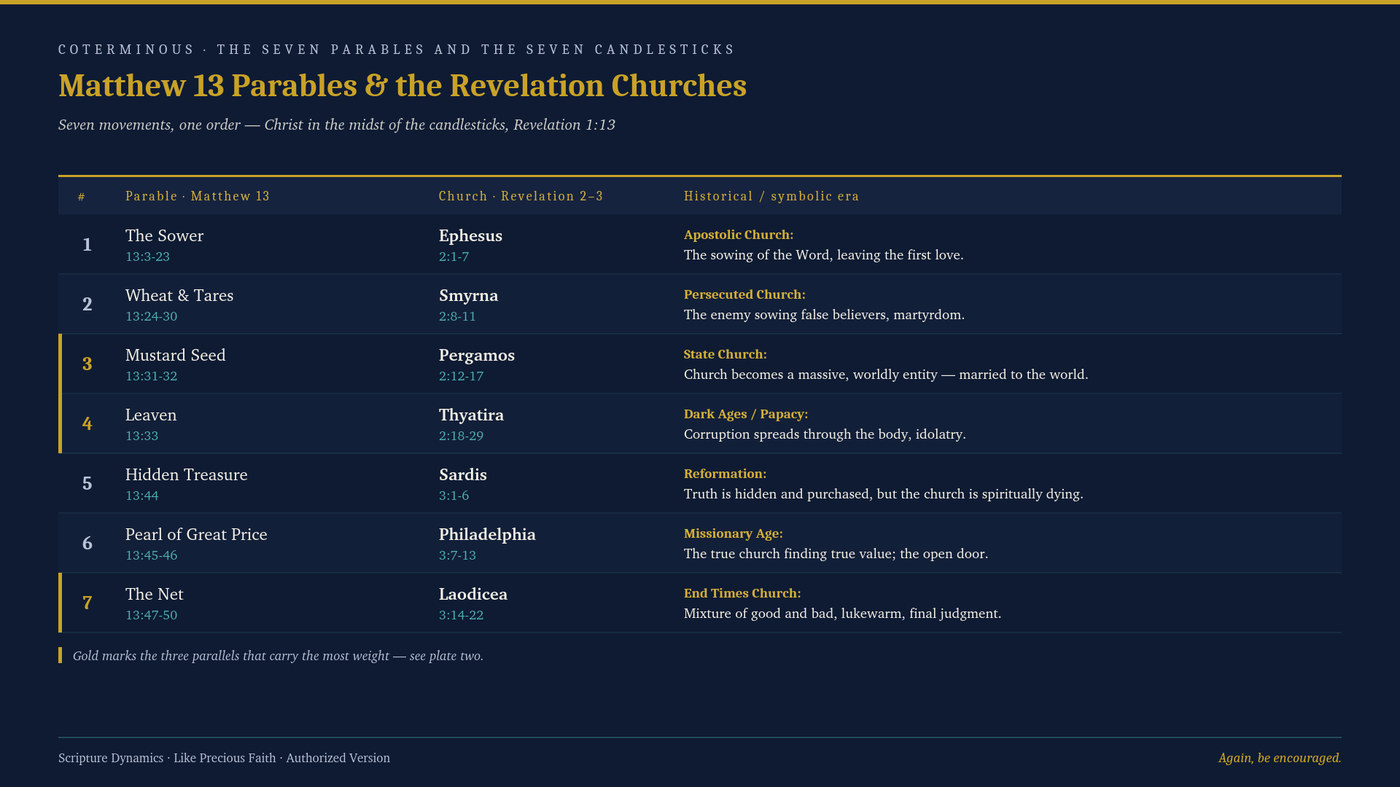
Seven movements, one order — Christ in the midst of the candlesticks, Revelation 1:13.
—The seven parables
| Parable | What it carries |
|---|---|
| The Sower (13:3–9) | The preaching of the Gospel. |
| The Tares (13:24–30) | The introduction of false believers by the enemy. |
| The Mustard Seed (13:31–32) | The church grows abnormally large and worldly, providing shelter for unclean birds. |
| The Leaven (13:33) | The corruption of doctrine within the church. |
| The Hidden Treasure (13:44) | Israel, or the remnant, hidden in the field and purchased by Christ. |
| The Pearl of Great Price (13:45–46) | The true church, purchased by Christ. |
| The Net (13:47–50) | Final judgment, separating the wicked from the righteous. |
—The seven churches
| Church | Its condition |
|---|---|
| Ephesus (2:1–7) | Loveless; works-oriented. |
| Smyrna (2:8–11) | Suffering; persecuted. |
| Pergamos (2:12–17) | Compromising; married to the world. |
| Thyatira (2:18–29) | Idolatrous; corrupt. |
| Sardis (3:1–6) | Dead; works without life. |
| Philadelphia (3:7–13) | Faithful; missionary-minded. |
| Laodicea (3:14–22) | Lukewarm; self-sufficient. |
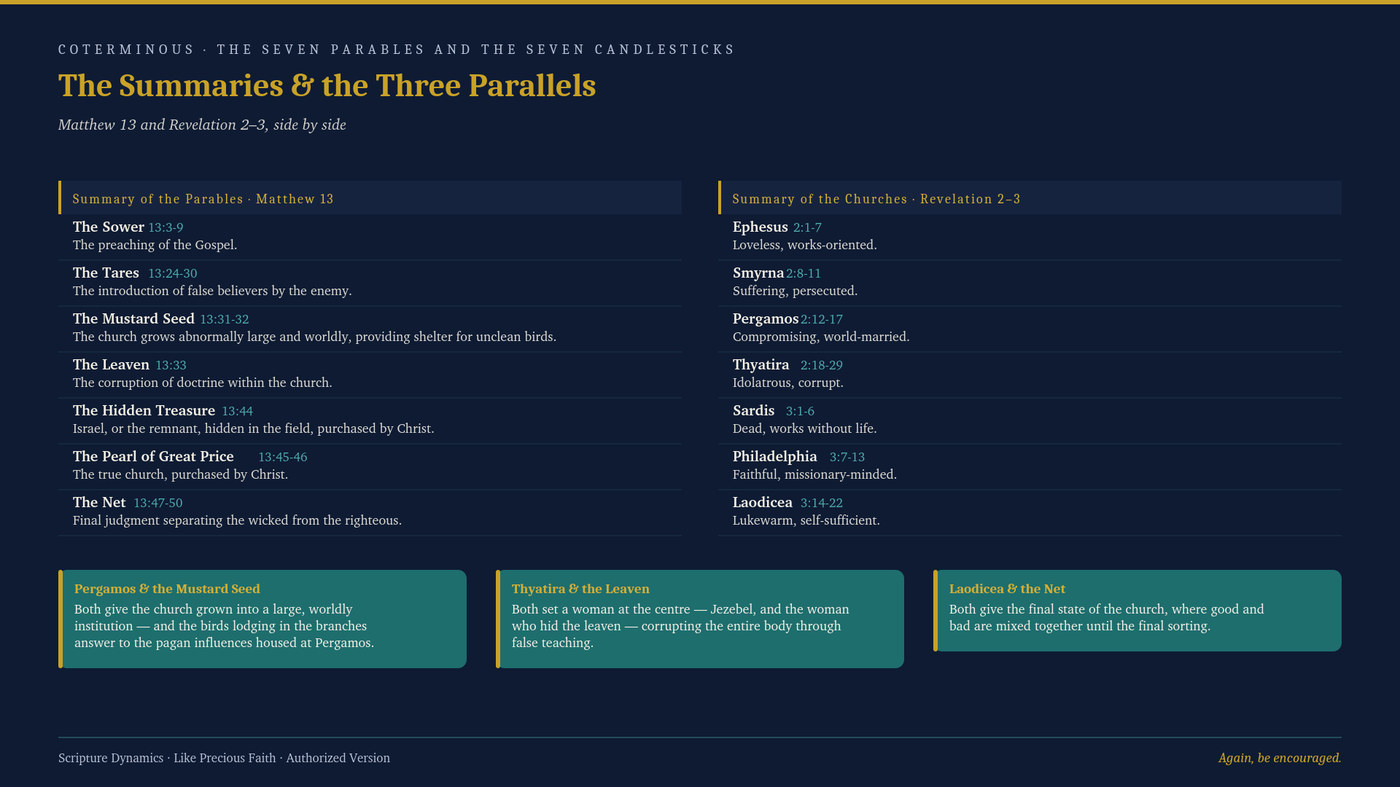
—Three parallels that carry the most weight
Pergamos and the Mustard Seed. Both give the church grown into a large, worldly institution — and the birds lodging in the branches answer to the pagan influences housed at Pergamos.
Thyatira and the Leaven. Both set a woman at the centre — Jezebel, and the woman who hid the leaven — corrupting the whole body through false teaching.
Laodicea and the Net. Both give the final state of the church, good and bad gathered together until the sorting.
Pergamos, not Pergamum. Set to Pergamos throughout.
The Hidden Treasure has two referents in your own text. The chart glosses it as truth hidden and purchased; the parable summary glosses it as Israel, or the remnant, hidden in the field. Those are different subjects. Both are carried above as you wrote them, but the chart cannot teach two referents for one parable. Yes, different subjects originating and terminating in the Person and Work of Christ (not consisting though as it pertains to national ethnic Israel’s blindness / vail).
The Sower carries two ranges. The chart gives 13:3–23, which takes in the Lord’s own interpretation.
Again, be encouraged.
—Appendix A. Authorized Version Verification
Every reference used in this module is listed below for personal verification against the Authorized Version before teaching, recording, or publication.
| Reference | Verified | Reference |
|---|---|---|
| Isaiah 43:11 | ☐ | John 4:42 |
| Acts 20:28 | ☐ | Psalm 49:7–8 |
| Revelation 5:3 | ☐ | Hebrews 9:12 |
| Leviticus 25:25 | ☐ | Revelation 5:2 |
| 2 Corinthians 5:21 | ☐ | Hebrews 2:14 |
| Galatians 4:4–5 | ☐ | Revelation 5:1 |
| Leviticus 25:23 | ☐ | Daniel 7:14 |
| Job 33:24 | ☐ | Ezekiel 33:13 |
| Genesis 4:15 | ☐ | Exodus 12:13 |
| 1 John 3:12 | ☐ | 1 Peter 1:18–19 |
| Galatians 3:13 | ☐ | John 6:63 |
| 2 Corinthians 1:10 | ☐ | Colossians 1:14 |
| Hebrews 9:14 | ☐ | Romans 8:23 |
| Romans 8:11 | ☐ | Exodus 6:1 |
| Exodus 6:6 | ☐ | Exodus 14:14 |
| Ephesians 4:30 | ☐ | Ephesians 2:8–9 |
| Ephesians 2:10 | ☐ | 1 Corinthians 3:15 |
| Ephesians 1:10 | ☐ | Revelation 4:10 |
| Revelation 5:9 | ☐ | Revelation 5:12 |
Purchased at the cross, received in totality at the end
Sealed unto the day of redemption in the meantime
Nothing terminates in the redeemed
“Worthy is the Lamb”
Again, be encouraged.